Abstract
This paper discusses the thermal resistance of metal dust concrete block. The thermal insulation capacity of the block, coefficient of thermal expansion as well as mass loss of the blocks due to heating of the block were experimentally investigated. The effects of elevated temperature on the compressive strength of the block were discussed and compared with the unheated metal dust concrete block and conventional concrete blocks. The optimum compressive strength of the unheated metal dust block was 18.20N/mm2 and its corresponding heated specimen was 17.5N/mm2, at a temperature of 200°C. The compressive strength of the controlled specimen was 16.5N/mm2 and at a temperature of 200°C, the compressive strength was 15.3N/mm2. The coefficient of thermal expansion for the metal dust block with the optimum compressive strength was 14.12×10⁻⁶ as against 10.51×10⁻⁶ for the conventional block. The thermal insulation performance of the blocks was assessed by measuring the temperature rise on the unexposed side during a fire resistance test. The results suggest that metal dust increases the compressive strength of the block at a considerable replacement level, but when exposed elevated temperature of about 600°C, the block thermal properties deteriorated due to melting of the dust, evaporation of bound and free water in the block and other factors.
Keywords
Metal Dust, Elevated Temperature, Coefficient of Thermal Expansion, Insulation, Mass Loss
1. Introduction
The use of natural resources such as sand, stones, quarry dust and others has resulted in drastic degradation of the environment and the destruction of agricultural lands in the process of sand mining. To address the growing environmental challenges, it is vital to use materials that can reduce the ecological effects of these construction activities. One approach involves incorporating by-products and waste materials into building components, thereby reducing resource extraction and minimizing waste disposal issues. Several researchers have recognized the potential of such materials in reducing environmental degradation and promoting circularity through recycling and the reuse of industrial waste but not compromising with the mechanical properties of the final product.
The use of alternative materials in concrete can enhance the mechanical properties of the final products. Fly ash
and slug have been shown to increase the durability and workability of concrete while reducing the water demand. Coconut shell
| [2] | Zunna, S. U., Aziz, F. N. A. A., Cun, P. M. Characterization of lightweight cement concrete with partial replacement of coconut shell fine aggregate. SN Appl. Sci. 2019, 1(649). https://doi.org/10.1007/s42452-019-0629-7 |
[2]
in concrete have also improved the tensile and flexural strength of concrete. Patel et. al.
| [3] | Patel, R., Ahmed, Z., & Sharma, S. Corrosion Resistance of Metal Dust Concrete in Coastal Structures. Marine Engineering Journal, 2021, 15(1), 52-67. |
[3]
reported that the PET aggregates also decrease water absorption rate of concrete. Other materials such as recycled aggregates and metal dust have the potential to improve specific properties like compressive strength, tensile strength and resistance to environmental stress
| [4] | Kumar, A., & Gupta, R. Effects of Metal Dust on Mechanical Properties of concrete. Journal of Civil Materials, 2021, 11(3), 212-230. |
[4]
.
Metal dust, a fine byproduct from industrial metal working processes, has emerged as a promising material for sustainable construction. Studies suggest that concrete containing metal dust exhibits enhanced mechanical properties such as increased compressive strength and durability.
| [5] | Singh, R., & Patel, M. Compressive Strength Enhancement in Metal Dust Concrete. Journal of Construction Engineering, 2020, 14(2), 98-110. |
[5]
Patel et al.
| [4] | Kumar, A., & Gupta, R. Effects of Metal Dust on Mechanical Properties of concrete. Journal of Civil Materials, 2021, 11(3), 212-230. |
[4]
indicated that moderate replacement levels (up to 10%) improved tensile strength due to better particle interaction and bonding. Though metal dust has the potential of reducing water absorption rate of the concrete, careful control of the replacement percentage is necessary to avoid compromising the material’s resistance to water ingress.
| [6] | Bhattacharya, T., & Das, A. Optimizing Water Absorption in Metal Dust Concrete. Journal of Sustainable Construction, 2022, 8(3), 45-67. |
[6]
.
Workability is a critical property of concrete, particularly for ensuring ease of handling and placement during construction. Ahmed et al.
| [7] | Ahmed, M., Khan, R., & Gupta, A. Advanced Analytical Modeling of Metal Dust Concrete for Earthquake-Prone Regions. Journal of Computational Engineering, 2021, 9(2), 33-48. |
[7]
however reported that, the metal dust concrete exhibits reduced workability as the replacement level increased. At higher replacement levels, the concrete mix became stiff and difficult to pour, primarily due to the fine nature of the metal dust particles, which increased the water demand.
Though thorough research has been done in the use of metal dust in concrete blocks, the thermal properties of the block such as thermal insulation, coefficient of thermal expansion, thermal conductivity, thermal diffusivity and specific heat which play important role in the behavior of ordinary concrete at elevated temperature need more investigation. In construction, the testing of thermal insulation materials is crusial for determining how well these materials can prevent heat transfer between the inside and outside of a building. The performance of insulation affects energy efficiency, heating and cooling cost and overall comfort.
Mass loss in concrete refers to the reduction in material mass resulting from factors such as chemical attacks, abrasion, erosion and thermal exposure. It is important to assess the mass loss of metal dust concrete during fire exposure to determine the durability and longevity of the material particularly in harsh conditions and in industrial areas and regions with bad weather conditions.
The aim of the research is to study thermal behavior of the metal dust blocks under elevated temperature. This was achieved experimentally by meeting the objectives below;
a) Weight and heat-induced weight losses.
b) Determine the compressive strength of the block at elevated temperature.
c) Determine the coefficient of thermal expansion.
d) Determine the thermal insulation of the block.
2. Methodology
2.1. Specimen Design
The conventional concrete block specimen to be used as a control specimen was molded using a ratio of 1:3:3, with a water cement ratio of 0.5. A typical twenty eight days (28) compressive strength of the proposed mix ratio was 16N/mm2. The size of the blocks molded was 150×150×150 using materials that were tested at the laboratory to satisfy relevant codes of practice.
Portland cement was used as the primary binding agent for the aggregates in this study, adhering to the requirements for high-performance concrete mixes. Sand was used as fine aggregate in this experiment; a sieve analysis of the sand was performed in accordance with ASTM E11 standards with fine aggregates passing through a 1.18 mm sieve and residue being discarded. A 16 mm aggregate size was selected as coarse aggregates, and a sieve analysis was performed following ASTM E11 standards to ensure the desired grading.
Potable water from a piped source was used for concrete mixing and curing. The water was free of harmful contaminants, meeting the standard requirements for concrete production. The use of potable water will ensure that the concrete mixture remains uncontaminated and achieves the intended strength during the curing process. This was done to prevent rusting of the metal dust component from any chemical attack.
The metal dust was used as partial replacement for the fine aggregates in the specimen. The metal dust was collected from a steel warehouse that manufactures trusses from structural steel and aluminium and zinc roofing sheets.
The dust was sieved according to ASTM E11 requirements, and the experiment used a sieve that retains particles of 1.18 mm, the most prevalent size.
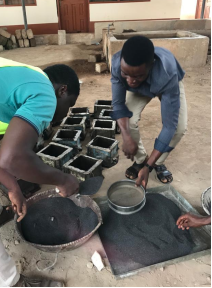
Figure 1. Sieving of constituents.
Having determined the volume of the concrete block to be 0.003375m
3 and using a ratio of 1:3:3 for cement, sand, and chipping respectively. The partial replacement of the sand with metal dust was done with a percentage interval of 15%, 30%, 45% and 60%. A summary of the dry volumes of the various constituents for all specimens is shown in
Table 1. The expected compressive strength control specimen was 16 N/mm
2 -20N/mm
2.
Table 1. Volumes of dry constituents for all specimens.
Specimen | Cement content ( | Fine aggregate ) | Metal dust ( | Coarse aggregate ( |
| 482.10 | 1446 | 0.0 | 1446 |
| 482.10 | 1229 | 216.90 | 1446 |
| 482.10 | 1012 | 433.80 | 1446 |
| 482.10 | 7953 | 650.70 | 1446 |
| 482.10 | 578.40 | 867.60 | 1446 |
2.2. Batching, Mixing, and Curing
The concrete components, including sand, aggregates, and coarse sand, were weighed and dried over three days. Metal dust and water were then added in calculated quantities to the dry mixture, and were mixed homogeneously. The mixture was manually compacted in layers using a tamping bar in the molds, and the surface of each specimen were smoothed after thorough compaction. After 24 hours, the specimens were demolded and transferred into curing tanks, where they were submerged in water for 28 days to complete.
3. Experimental Setup
3.1. Heat-Induced Mass Loss
The effect of metal dust on the weight of the concrete is experimentally determined using an electronic scale. Three blocks each of the various specimens were weighed and their mean values were determined. The average weight of the blocks was recorded and compared with the control specimen to analyze the effect of the metal dust on the weight of the blocks. To assess the effect of elevated temperature on the blocks, three blocks each of the various specimen were heated at a temperature of 200°C and 600°C and their corresponding weight were measured on an electric balance. The effect of heat on the weight of the blocks was then analysed. According to A. Omer
| [8] | Omer, A. Effects of higher temperature on properties of concrete. Fire and safty Journal, 2007, 42(8): 516-522. |
[8]
, temperatures as low as 200°C can cause visible cracking and weight loss, while complete decomposition can occur around 1200°C on concrete blocks.
3.2. Compressive Strength Test
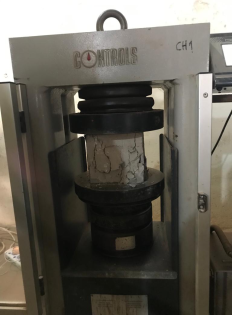
The compressive strength test is conducted to determine the ability of the structure to carry compressive loads. Thus, the weight of the cubes belonging to each of the specimen groups was determined using an electronic balance and recorded. The average weight and dimensions of the controlled specimens SP0 were fed into the universal testing machine per ASTM C90-21 standards. One specimen at a time was tested until the specimen failed.
Figure 2. Experimental set-up for compressive strength testing.
The failure loads and strength were then recorded. The procedure was repeated until all the three (3) cube specimens were tested for each percentage replacement. This procedure was repeated until the entire metal dust cubes for all the specimens were tested for their compressive strength. The same procedure was repeated for the specimens of the various constituents which were subjected to and elevated temperature of 200°C and 600°C in an electric oven for a period of 3 hours.
3.3. Thermal Expansion
The thermal expansion test consists of heating the specimen in an electric oven to a temperature of 1800 C for a period of 3 hours to attain thermal equilibrium. This temperature was used to make sure the blocks did not undergo instant cracked initiation during the heating period, but allowed to slowly expand. During the heating time, the temperature inside the concrete blocks is monitored by inserting thermocouples inside each block, to ensure that at all times the temperatures inside the blocks attains were sustained at the required temperature of 180°C. Upon the completion of the heating period, the blocks were then removed with care and measurements of the dimensions of the blocks are then retaken using the micrometer screw gauge to determine the linear thermal expansion. The coefficient of linear thermal expansion (alpha) is determined by the following formula:
in which
L = length,
Lo = initial length and
ΔT = change in temperature
3.4. Thermal Insulation
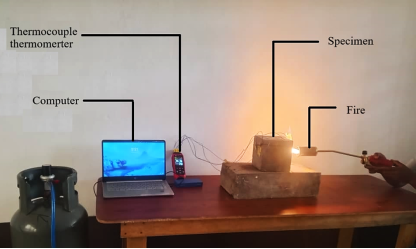
A guarded furnace setup with gas pipe providing heat of high temperature 180℃ was set to one side of the block, temperature variations on both the exposed and unexposed sides were monitored and recorded after the durations of 4hours using a K-type thermocouple thermometer with four channels. Two channels were placed at the exposed side of the block to heat and the other two were placed at the unexposed side of the block.
The temperatures on each side of the block were recorded and their mean values were analysed. The temperature at the unexposed side of the blocks after 4 hours were then plotted against the time to study the thermal insulation capacity of the blocks at each level of replacement. The experimental set up for the thermal insulation test is shown in the
Figure 3.
Figure 3. Experimental set-up for thermal Insulation test.
4. Results and Discussion
4.1. Weight and Heat-Induced Mass Loss
The results of the weights of the various specimens are shown in the
Table 2 below, it can be seen that, as the quantity of metal dust increases, the weight of the blocks also increased.
Table 2. Weight if unheated and heated specimens.
Specimen ID | Unheated weight (g) | Heated 200°C Weight (g) | Heated 600°C Weight (g) |
SP0 | 7572 | 7540 | 7450 |
SP1 | 7795 | 7720 | 7607 |
SP2 | 7980 | 7890 | 7780 |
SP3 | 8077 | 7980 | 7817 |
SP4 | 8812 | 8710 | 8020 |
This is because the metal dust constituents are heavier than the sand constituents. As the temperature is increased from 0°C to 200°C, there is a slight decrease in the weight for both the conventional blocks and the metal dust blocks. This decrement may be attributed to the evaporation in the bound and free water in the concrete and other factors. The bound and free water in the concrete evaporates at temperatures of about 100–110 °C. O Tanash et al.
| [9] | Tanash, A. O., Abu Bakar. B. H., Muthusamy, K. Effect of elevated temperature on mechanical properties of normal strength concrete: An overview. Materialstoday procedings. 2024, Volume 107, 2024, Pages 152-157. https://doi.org/10.1016/j.matpr.2023.09.053 |
[9]
.
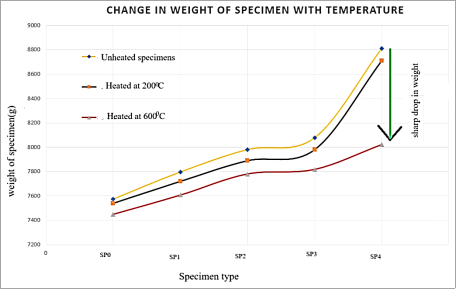
A graph of the weight for the blocks for the various temperatures is shown in
Figure 4. The more the dust component, the higher the reduction in weight at 600°C. This shows that, metal dust constituent decomposes faster at a higher temperature than the other constituents
Figure 4 shows a sharp drop in the weight of the metal dust block at temperature of 600°C as compared to the other temperatures for various specimens. SP
2 and SP
3 which has 15% and 30% replacement slightly maintained a consistent weight drop, however beyond 30% replacement, when more dust is added, the weight dropped sharply at 600°C.
Figure 4. Effect of temperature on the weight of the blocks.
This is probably due to the expansion of the dust particles and subsequent debonding and removal from the surfaces of the block. It could also be due to the burning of the particles and evaporation Metal particles such as aluminum has a melting point of range of 566-650°C while the melting point of zinc 420°C. Since the dust particles are collected from the factory where steel trusses and roofing sheet were manufactured, the possibility of having these metal particles in large quantities in the metal dust constituents is high. Chandramoul et. al.
| [10] | Chandramoul, K., Srinivasa, R. P., Sravana, P. The effect of weight loss on high strength concrete at different temperature and time. Journal of Emerging Trends in Engineering and Applied Sciences, 2011, Vol. 2, No. 4. |
[10]
conducted a test on concrets, prepared with M40 and M50 grade of ordinary concrete. The percentage weight loss of ordinary concrete mixes after exposing the specimens from 200°C, 400°C and 600°C of exposure time of 4, 8 and 12 hours. duration is observed to be varied from 4.7 to 4.8.
4.2. Compressive Test
The results for the compressive strength of the various specimen are tabulated below.
Table 3. Summary of results for the average Compressive strength test.
specimen | Unheated N/mm2 | Heated (200°C) N/mm2 | Heated (600°C) N/mm2 |
SP0 | 16.58 | 15.3 | 12.5 |
SP1 | 15.41 | 15.1 | 11.4 |
SP2 | 18.20 | 17.5 | 13.2 |
SP3 | 15.31 | 14.4 | 11.1 |
SP4 | 13.04 | 12.4 | 10.1 |
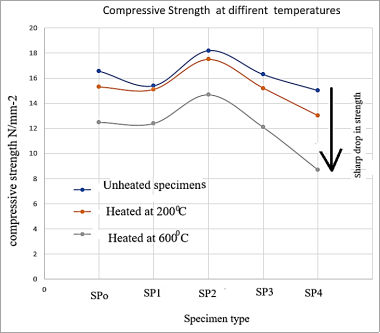
The compressive strength of the unheated metal dust specimen increased as the percentage replacement increases up 30% replacement where optimum strength was achieved (18.2N/mm
2). There was continuous decrement in compressive strength after each additional metal dust added. At 60% replacement, the compressive strength dropped to 13.042N/mm
2 Results attained by other studies demonstrate that the addition of metal dust enhances the compressive strength of concrete at moderate replacement levels. Singh et al.
| [11] | Singhal, P., Sharma, M., & Gupta, A. Impact of Metal Dust on Compressive Strength of Concrete. International Journal of Structural Engineering, 2021, 12(2), 112-125. |
[11]
conducted an experiment where metal dust was introduced in varying proportions, revealing that replacement levels of 10-15% resulted in a 10-15% increase in compressive strength compared to conventional concrete. It can be concluded that, at optimum replacement level the compressive strength of the block increased as the metal dust fills the internal pores of the microstructure of the concrete making the block more compact, denser and stronger structure. However further increment renders the block to become more brittle and breakable.
Figure 5. Compressive strength of specimen at different temperatures.
Concrete go through chemical and physical changes when exposed to higher temperatures which has the probability of reducing their strength. Heating sand grains and other components equally expands due to kinetic energy, causing overall separation of the particle, creating pores in the concrete which makes it weaker than the unheated block. Materials such as metal fiber loses stiffness when expanded under heat. It can be seen from the table that, at 200°C the weight of the blocks reduced basically through the removal of bound and free water, the compressive strength also decreased slightly, but as the temperatures were further increased to 600°C, the expansion of the materials, especially the metal dust caused debonding in the block making it loose further strength.
Figure 5 shows a sharp drop in strength of the specimen SP
4 when heated at 600°C. this shows that, the more the metal dust were added, the more brittle the blocks became when heated at a high temperature, making it deform easily under the lest compressive force.
4.3. Thermal Expansion Coefficient
Factors such as cementitious material content, water- cement ratio, range of temperature, concrete age and relative humidity can influence thermal properties of concrete.
Table 3 shows the experimental results for all specimens used, three blocks each of the various specimen groups were used and the results were analyzed using their mean values. The coefficient of linear thermal expansion (α) for each of the specimens were calculated and tabulated using formular (
1).
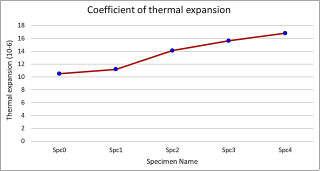
Comparing the metal dust block to the conventional concrete block, a conclusion can be drawn that the coefficient of the thermal expansion of the concrete block increased when the percentage of the dust were increased. A graphic presentation was also completed to show the influence of metal dust on the coefficient of metal dust concrete blocks.
Table 4. Test results of specimens for the coefficient of linear thermal expansion.
Specimen | Expansion Coefficient (α) |
Spc0 | 10.51*10-6 |
Spc1 | 11.19*10-6 |
Spc2 | 14.12*10-6 |
Spc3 | 15.63*10-6 |
Spc4 | 16.86*10-6 |
The coefficient of linear thermal expansion for concrete ranges from 10*10
-6 to 13*10
-6, similarly, Wilmer and Peter
| [12] | Wilmer, S., Peter H., Thermal Expansion of a Few Steels. Scientific Papers of the Bureau of Standards, 1921, vol. 17, 611-626. |
[12]
reported that the coefficient of linear thermal expansion of steel to be 14*10
-6. If the concrete contains aggregate with a low coefficient of expansion, its thermal coefficient is reduced considerably. However, if the aggregate has a high thermal expansion rate the thermal expansion of the concrete is comparatively higher.
| [13] | Johnson, W. H., Parsons, W. H. Thermal expansion of concrete aggregate materials. Journal of Research and National Bureau of Standard, 1944, Vol. 32, pp 101-126. |
[13]
.
Figure 6. Coefficient of thermal expansion for all specimens.
At the higher temperature of exposure, the heat energy causes the atoms in the metal to vibrate more rapidly and take up more space which causes the metal to expand. The presence of the dust at 60% replacement makes it more susceptible to expansion as compared with the other constituent, this is evident in the results, as specimen SP4 had higher thermal expansion coefficient than SP1.
4.4. Thermal Insulation Capacity
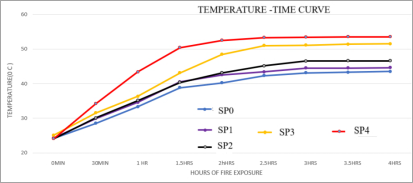
The specimens were exposed to a temperature of 120°C for a period of 4 hours, instead of 600°C. This was to allow the heat to transfer gently through the block without causing damage to it. Results of the temperatures at the unexposed side were recorded and sampled after every 30 minutes using a data logger and plotted in
Figure 7. It can be seen that, the more the metal dust constituents were increased, the faster and higher the temperature at the unexposed side rose. The curve generated for the temperature values at the unexposed side was similar to the fire curve by the IS0-834 standard.
Table 5. Temperatures of Specimens at Unexposed Side.
TIME | SP0 | SP1 | SP2 | SP3 | SP4 |
0MIN | 24.2 | 24.3 | 24.1 | 25.1 | 24.1 |
30MIN | 28.5 | 29.9 | 30.1 | 31.5 | 34.2 |
1HR | 33.3 | 34.6 | 35.1 | 36.3 | 43.4 |
1.5HRS | 38.8 | 40.5 | 40.3 | 43.1 | 50.4 |
2hHRS | 40.2 | 42.5 | 43.1 | 48.4 | 52.5 |
2.5HRS | 42.3 | 43.4 | 45.1 | 51 | 53.3 |
3HRS | 43.1 | 44.5 | 46.5 | 51.1 | 53.4 |
3.5HRS | 43.3 | 44.5 | 46.6 | 51.4 | 53.5 |
4HRS | 43.5 | 44.6 | 46.6 | 51.5 | 53.5 |
Figure 7. Thermal insulation for various block specimens.
To improve insulation in normal concrete blocks, lighter weight aggregates with low water absorption rate is considered.
| [14] | Zhuang, S., Wang, Q., Zhang, M. Water absorption behaviour of concrete: Novel experimental findings and model characterizationJournal of Building Engineering, 2022, Volume 53, 1 August 2022, 104602. https://doi.org/10.1016/j.jobe.2022.104602 |
[14]
. Lightweight concrete is reported to be good thermal insulators due to low thermal expansion coefficient and low thermal conductivity
| [15] | Malik, M., Bhattacharyya, S. K. Thermal and mechanical properties of concrete and its constituents at elevated temperatures: A review. Construction and Building Materials, 2021, Volume 270, 121398. |
[15]
. As the percentage of the dust constituents increases, the thermal conductivity of the block also increases thereby decreasing insulation capacity of the block.
5. Conclusion and Recommendations
It is evident from all the results shown above that specimen SP2 which had 30% partial replacement of the sand with metal dust constituent gave optimum results. Though the weight of SP2 is still bigger than the control specimen, its compressive strength with and without the application of higher temperatures were higher than the control specimen. The main objective of using metal dust to replace the sand to reduce environmental pollution was therefore achieved. Since the dust were obtained from waste metal fillings, the cost of producing the block would eventually be lesser than the conventional blocks. At the worst case scenario where excess heat attacks the blocks, it has been proven that, the coefficient of thermal expansion and thermal insulation of the blocks exhibited encouraging result which were still within the working limits in standard codes of practice. It is recommended that a linear programming model and machine learning methods be formulated for optimization models for the production of the metal dust block, specifically SP2 specimen.
Abbreviations
ASTM | American Society for Testing and Materials |
SP0 | Controlled Specimen |
SP1 | Specimen 1 |
SP2 | Specimen 2 |
SP3 | Specimen 3 |
SP4 | Specimen 4 |
PSB | Plastic Sand Block |
Author Contributions
Adutwum Marfo: Conceptualization, Data curation, Formal Analysis, Funding acquisition, Investigation, Methodology, Supervision, Writing – original draft, Writing – review & editing
Angel Kyilo Gam: Data curation, Formal Analysis, Investigation, Methodology, Project administration, Resources, Validation, Writing – original draft, Writing – review & editing
Baah Isabella: Formal Analysis, Investigation, Methodology, Resources, Software, Validation, Visualization, Writing – review & editing
Conflicts of Interest
The authors declare no conflicts of interest.
References
| [1] |
Charles, B., Jingyi, Z., Wayne, J., Maher, T. High-percentage replacement of cement with fly ash for reinforced concrete pipe. Cement and Concrete Research. 2005, 35(6), 1088-1091.
https://doi.org/10.1016/j.cemconres.2004.06.040
|
| [2] |
Zunna, S. U., Aziz, F. N. A. A., Cun, P. M. Characterization of lightweight cement concrete with partial replacement of coconut shell fine aggregate. SN Appl. Sci. 2019, 1(649).
https://doi.org/10.1007/s42452-019-0629-7
|
| [3] |
Patel, R., Ahmed, Z., & Sharma, S. Corrosion Resistance of Metal Dust Concrete in Coastal Structures. Marine Engineering Journal, 2021, 15(1), 52-67.
|
| [4] |
Kumar, A., & Gupta, R. Effects of Metal Dust on Mechanical Properties of concrete. Journal of Civil Materials, 2021, 11(3), 212-230.
|
| [5] |
Singh, R., & Patel, M. Compressive Strength Enhancement in Metal Dust Concrete. Journal of Construction Engineering, 2020, 14(2), 98-110.
|
| [6] |
Bhattacharya, T., & Das, A. Optimizing Water Absorption in Metal Dust Concrete. Journal of Sustainable Construction, 2022, 8(3), 45-67.
|
| [7] |
Ahmed, M., Khan, R., & Gupta, A. Advanced Analytical Modeling of Metal Dust Concrete for Earthquake-Prone Regions. Journal of Computational Engineering, 2021, 9(2), 33-48.
|
| [8] |
Omer, A. Effects of higher temperature on properties of concrete. Fire and safty Journal, 2007, 42(8): 516-522.
|
| [9] |
Tanash, A. O., Abu Bakar. B. H., Muthusamy, K. Effect of elevated temperature on mechanical properties of normal strength concrete: An overview. Materialstoday procedings. 2024, Volume 107, 2024, Pages 152-157.
https://doi.org/10.1016/j.matpr.2023.09.053
|
| [10] |
Chandramoul, K., Srinivasa, R. P., Sravana, P. The effect of weight loss on high strength concrete at different temperature and time. Journal of Emerging Trends in Engineering and Applied Sciences, 2011, Vol. 2, No. 4.
|
| [11] |
Singhal, P., Sharma, M., & Gupta, A. Impact of Metal Dust on Compressive Strength of Concrete. International Journal of Structural Engineering, 2021, 12(2), 112-125.
|
| [12] |
Wilmer, S., Peter H., Thermal Expansion of a Few Steels. Scientific Papers of the Bureau of Standards, 1921, vol. 17, 611-626.
|
| [13] |
Johnson, W. H., Parsons, W. H. Thermal expansion of concrete aggregate materials. Journal of Research and National Bureau of Standard, 1944, Vol. 32, pp 101-126.
|
| [14] |
Zhuang, S., Wang, Q., Zhang, M. Water absorption behaviour of concrete: Novel experimental findings and model characterizationJournal of Building Engineering, 2022, Volume 53, 1 August 2022, 104602.
https://doi.org/10.1016/j.jobe.2022.104602
|
| [15] |
Malik, M., Bhattacharyya, S. K. Thermal and mechanical properties of concrete and its constituents at elevated temperatures: A review. Construction and Building Materials, 2021, Volume 270, 121398.
|
Cite This Article
-
ACS Style
Marfo, A.; Gam, A. K.; Isabella, B. Experimental Investigation of the Thermal Resistance of Metal Dust Concrete Block. J. Civ. Constr. Environ. Eng. 2025, 10(5), 182-190. doi: 10.11648/j.jccee.20251005.12
 Copy
|
Copy
|
 Download
-
@article{10.11648/j.jccee.20251005.12,
  author = {Adutwum Marfo and Angel Kyilo Gam and Baah Isabella},
  title = {Experimental Investigation of the Thermal Resistance of Metal Dust Concrete Block
},
  journal = {Journal of Civil, Construction and Environmental Engineering},
  volume = {10},
  number = {5},
  pages = {182-190},
  doi = {10.11648/j.jccee.20251005.12},
  url = {https://doi.org/10.11648/j.jccee.20251005.12},
  eprint = {https://article.sciencepublishinggroup.com/pdf/10.11648.j.jccee.20251005.12},
  abstract = {This paper discusses the thermal resistance of metal dust concrete block. The thermal insulation capacity of the block, coefficient of thermal expansion as well as mass loss of the blocks due to heating of the block were experimentally investigated. The effects of elevated temperature on the compressive strength of the block were discussed and compared with the unheated metal dust concrete block and conventional concrete blocks. The optimum compressive strength of the unheated metal dust block was 18.20N/mm2 and its corresponding heated specimen was 17.5N/mm2, at a temperature of 200°C. The compressive strength of the controlled specimen was 16.5N/mm2 and at a temperature of 200°C, the compressive strength was 15.3N/mm2. The coefficient of thermal expansion for the metal dust block with the optimum compressive strength was 14.12×10⁻⁶ as against 10.51×10⁻⁶ for the conventional block. The thermal insulation performance of the blocks was assessed by measuring the temperature rise on the unexposed side during a fire resistance test. The results suggest that metal dust increases the compressive strength of the block at a considerable replacement level, but when exposed elevated temperature of about 600°C, the block thermal properties deteriorated due to melting of the dust, evaporation of bound and free water in the block and other factors.},
 year = {2025}
}
Copy
|
Download
-
TY  - JOUR
T1  - Experimental Investigation of the Thermal Resistance of Metal Dust Concrete Block

AU  - Adutwum Marfo
AU  - Angel Kyilo Gam
AU  - Baah Isabella
Y1  - 2025/10/14
PY  - 2025
N1  - https://doi.org/10.11648/j.jccee.20251005.12
DO  - 10.11648/j.jccee.20251005.12
T2  - Journal of Civil, Construction and Environmental Engineering
JF  - Journal of Civil, Construction and Environmental Engineering
JO  - Journal of Civil, Construction and Environmental Engineering
SP  - 182
EP  - 190
PB  - Science Publishing Group
SN  - 2637-3890
UR  - https://doi.org/10.11648/j.jccee.20251005.12
AB  - This paper discusses the thermal resistance of metal dust concrete block. The thermal insulation capacity of the block, coefficient of thermal expansion as well as mass loss of the blocks due to heating of the block were experimentally investigated. The effects of elevated temperature on the compressive strength of the block were discussed and compared with the unheated metal dust concrete block and conventional concrete blocks. The optimum compressive strength of the unheated metal dust block was 18.20N/mm2 and its corresponding heated specimen was 17.5N/mm2, at a temperature of 200°C. The compressive strength of the controlled specimen was 16.5N/mm2 and at a temperature of 200°C, the compressive strength was 15.3N/mm2. The coefficient of thermal expansion for the metal dust block with the optimum compressive strength was 14.12×10⁻⁶ as against 10.51×10⁻⁶ for the conventional block. The thermal insulation performance of the blocks was assessed by measuring the temperature rise on the unexposed side during a fire resistance test. The results suggest that metal dust increases the compressive strength of the block at a considerable replacement level, but when exposed elevated temperature of about 600°C, the block thermal properties deteriorated due to melting of the dust, evaporation of bound and free water in the block and other factors.
VL  - 10
IS  - 5
ER  -
Copy
|
Download





 Share This Article
 Twitter
 Linked In
 Facebook