Research Article | | Peer-Reviewed

Assessing the Utilization of Local Available Building Materials for Building Construction in FCT – Abuja, Nigeria

Received: 30 September 2025     Accepted: 16 October 2025     Published: 28 November 2025
Views:       Downloads:
Abstract

The potentials of available local building materials in Nigerian building industry remain untapped and seems to be progressing at a very slow percentage. This research therefore assessed the availability, level of usage, factors affecting the usage, the benefit of their usage and strategies to promote the use of available local building material in Federal Capital Territory, Abuja -Nigerian. Based on the extensive literature review, fifteen (15) available local building material in FCT., were identified and assessed. One hundred and forty (140) professionals closely involved with building construction in construction companies that are fully operational in FCT were examined for the assessment. Relative index analysis of the frequency in the use of available local building material for building construction in FCT., revealed that the following building materials are available and in the following order: Aggregate (1) with R.I.I. of 0.960, Timber (2) with R.I.I of 0.930, Laterite (3) with R.I.I of 0.926, Bamboo (4) with R.I.I of 0.910, Reeds (5) with R.I.I of 0.901, Rice Husk Ash (6) with R.I.I of 0.894 and among others. However, the level of usage of these materials is still low considering the economic benefits and factors associated with the use of available local building material. The research recommended more public awareness campaign and sensitization of the public on the use of available local building material in order to promote its acceptability in built environment. Creating polices to support the use of local building materials as well as intensifying research on the properties of available local building materials were also recommended as a strategy to promote the use of available local building material in Federal Capital Territory, Abuja – Nigeria.

Published in Journal of Civil, Construction and Environmental Engineering (Volume 10, Issue 6)
DOI 10.11648/j.jccee.20251006.14
Page(s) 242-252
Creative Commons

This is an Open Access article, distributed under the terms of the Creative Commons Attribution 4.0 International License (http://creativecommons.org/licenses/by/4.0/), which permits unrestricted use, distribution and reproduction in any medium or format, provided the original work is properly cited.

Copyright

Copyright © The Author(s), 2025. Published by Science Publishing Group

Keywords

Building Industry, Local Materials, Construction, Affordable Housing, Acceptability, FCT-Abuja

1. Introduction
Nigerian housing policy stated that affordable housing is that which cost the occupant not more than 30% of their annual income and less than 20% annual income in Nigeria . Despite all the governmental efforts and policies, construction of affordable, sustainable and functional buildings in the country have gone beyond the reach of low-income earner. Research conducted by Akinmoladun and Oluwoye reported that 30% to 40% of family income is swallowed by housing in Nigeria, which in essence breaches the tenets of the government policy. In a country where majority of the citizens are poor, accessibility of decent houses in a sanitized environment remains a dream for many Nigerians .
It is a known fact that building materials contribute significantly to the quality and cost of building, while the building materials industry is an important contributor to the national economy of any nation as its output governs both the rate and the quality of construction work .
It was reported that building materials are about 35% to 37% of construction cost component . This high cost of construction has been a source of concern to all relevant stakeholder in built environment in Nigeria. The key reason for high cost of construction in the country is the high cost of building materials which are largely imported materials. The imported materials attract high cost due to prices such as foreign exchange rate, freight, inflation, import duties, among others. It was reported that the rising cost of building due to materials has made it difficult for low-income earner to own affordable houses in Nigeria . The rising cost of building materials in the country suggest that local building materials are not well utilized. This could be attributed to the quality and quantity of the materials, social status, acceptability, lack of government policies among others. In view of the above it was suggested that a shift towards the usage of local building materials will solve the scenario of high construction cost in Nigeria. .
The local building materials are materials that are sourced locally, which are either occurring naturally or manufactured with locally sourced raw materials .
It was reported that the local building materials are within reach and they are cheaper and more affordable in cost when compared to imported materials . A number of researches shows that Nigeria is endowed with abundant natural resources that can meet their building materials production but they still depend largely on imported building materials in order to meet the construction needs . For instance, research conducted by Iwuagwu, Onyegiri and Iwuagwu shows that fibrous tree (used to produce good structural members for construction) are found mainly in the Middle Belt of Nigeria. In the same vein, (Oruwari et.al reported that grasses are found in abundant quantities in the Middle Belt and Northern region of Nigeria and they are used for the purpose of construction in the Nigerian traditional Architecture. Local building materials such as laterite, wood, thatch, bamboo, snail shell, cow dung, cowries, vines and creepers are readily available building materials in south western Nigeria .
Despite all the available local building materials in the country, a gradual decline in the use of locally manufactured building materials, as well as massive importation of building materials was reported Taiwo and Adeboye thus, greatly widening the gap between imports and exports. The need to embrace the usage of local building materials to achieve functional and affordable housing scheme in Nigeria has been suggested by Daramola . It was also reveals that high cost of building materials was one of the reasons why Nigerian government interventions in housing scheme failed . It was therefore suggested that the review of government’s restriction on imported materials and development of local building materials will drastically reduce the cost of construction .
Although government has made a lot of effort to encourage the use of locally produced building materials but there are several factors militating against their uses in building construction in Nigeria. Some of the factors include; legal acceptability, social acceptability, doubtful durability, high level of maintenance, technology to handle setting, uncertainty of cost, lack of standards and specification, problem of mass production, uncertainty about the demand and uncertainty about the strength of material when compared with their imported counterparts .
This research therefore aims at investigating the utilization of local building materials in Federal Capital Territory, Abuja – Nigeria. The research will examine the availability, usage of local building materials in Federal Capital Territory, Abuja and find out the factors that discourage their usage as well as pin point their benefits and identify ways to promote their usage. This research is significant because it will contribute towards the affordability of housing by bringing down the cost of material through the use of local available building materials.
2. Research Location
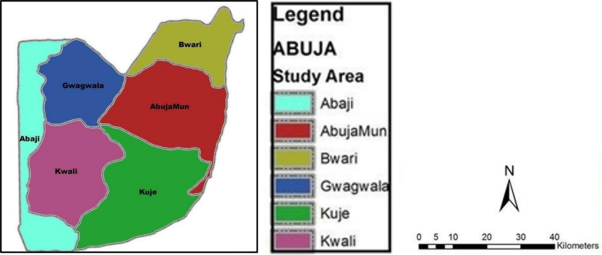
This research was conducted in Federal Capital Territory (FCT) – Abuja, Nigeria. The FCT, is the Capital Territory of Nigeria and was created in 1976. The FCT is located north of the confluence of the Niger and Benue rivers. The FCT comprises of six (6) Area Councils namely: Abaji, Abuja Municipal, Bwari, Gwagwalada, Kuje and Kwali as shown in Figure 1.
Figure 1. Map of Federal Capital Territory (FCT) – Abuja, Nigeria.
3. Research Methodology
This research adopted questionary method. The questionnaire was prepared to get information on the availability, usage of local building materials in Federal Capital Territory, Abuja and find out the factors that discourage their usage as well as pin point their benefits and identify ways to promote their usage. One hundred and sixty (160) duplicates of the prepared questionnaire were distributed to numbers of professional and consultants in the built environment (Engineers, Builders, Architects, Quantity Surveyors and Developer). The questionnaires were prepared so as to obtained general information of respondents on the usage of local available building materials factors limiting the use local available building materials, benefit of using local available building materials and strategy to promote the use of local available building materials.
A list of registered consultants was obtained from professional Registration Boards like Council for Regulation of Engineering (COREN), Council of Registered Builders of Nigeria (CORBON), Architect Registration Council of Nigeria (ARCON), Quantity Surveyors Registration Board of Nigeria (QSRBN) and Procurement Consultants.
The authors developed a questionnaire using the five (5) point Likert Scale Method {5 = Strongly Agreed (SA); 4 = Agreed (A); 3 = Neutral (N); 2 = Disagreed (D); and 1 = Strongly Disagreed (SD)}. Data obtained were analyzed using the frequency table and Relative Importance Index (R.I.I) approach that was advocated for, and used by Lim, E.C. and Alum, J. . The Relative Importance Index is given as: R.I.I. = (5x5+ 4x4+ 3x3+2x2+ 1x1) /5N) Where: x5= Strongly Agree (SA); x4= Agree (A); x3= Neutral (N); x2= Disagree (D); x1=Strongly Disagree (SD); and N = Total number of respondents.
4. Results and Discussion
Table 1 shows the analysis of questionnaire that were distributed during the research and number of questionnaires received after the distribution. Total number of questionnaires sent out were one hundred and sixty (160) copies out of which one hundred and forty (140) responses were obtained to give a return rate of 87.5%.
Table 1. Analysis of the questionnaire distributed.

Description

Total Number

Percentage (%)

Questionnaire sent to respondents

160

100

Questionnaire received from respondents

140

87.5

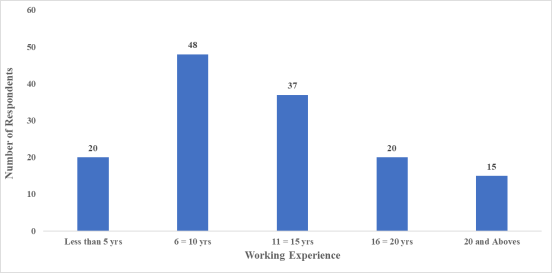
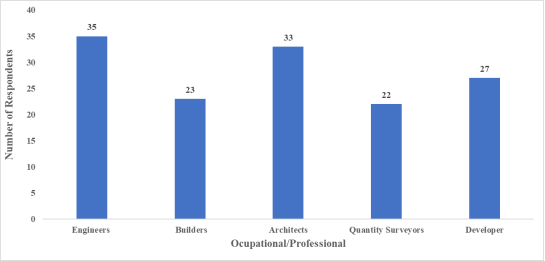
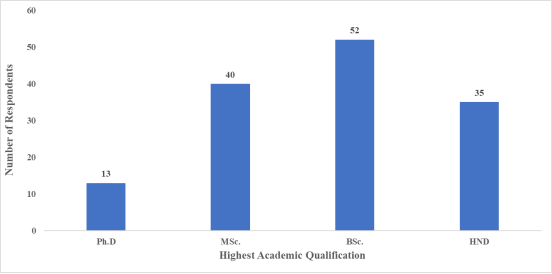
Figures 2-4 give an information about the respondents and this information includes the working experience of the respondent, occupation/profession of the respondent and the academic qualification of the respondent.
Figure 2. Working experience of respondents.
Figure 3. Occupation/profession of the respondents.
Figure 4. Academic qualification of the respondent.
Figure 2 shows that 14.30% of the respondents (20 in number) had less than 5 years of working experience, 34.30% of the respondents (48 in number) had 6 – 10 years working experience, 26.40% of the respondents (37 in number) had 11 – 15 years working experience, 14.30% had 16 –20 years working experience while 10.70% of the respondents (15 in number) had above 20 years of working experience.
Figure 3 revealed that 25% of the respondents (35 in number) were engineers, 16.40% of the respondents were builder, architects account for 23.60% of the respondents, 15.70% were quantity surveyors while 19.30% of the respondents were developers.
Figure 4 shows the academic qualifications of the respondents. 09.30% of the respondent had Ph.D, 28.60% had MSc., 37.10% of the respondents had BSc., while 25.00% had HND.
4.1. Data Analysis
Data obtained were analyzed and interpreted in this section.
4.2. Interpretation of Results
Before the commencement of this research, literatures review helped in identifying the available local building materials used in the building construction industry in Nigeria. After the analysis of various local building materials, a total of fifteen (15) local building materials were pick up for analysis. The identified local building materials were presented to respondents in the questionnaire format so as to determine their level of availability, usage, factors affecting their usage, benefit drive from using the material as well as strategy to promote the use of local available building materials in Federal Capital Territory (FCT), Abuja, Nigeria.
4.2.1. Available Local Building Material
Table 2, shows that, aggregate (fine and coarse) was found to be the most available local building material in FCT, Abuja, Nigeria. 85.71% of the respondents strongly agree that aggregates are always available for use as a local building material in FCT and its environs. Aggregates ranked first, with a Relative Importance Index (R.I.I.) of 0.926. This availability of aggregates could be attributed the numerous hills and mountains found in Abuja Municipal, Bwari and Kuje Area Council of FCT, Nigeria. The respondents ranked timber as the second most indigenous building material for building construction in FCT. 75% of the respondents strongly agree that timber is always available for use for building construction with R.I.I. of 0.930. This can be attributed to thick forest found in some part of Abuja Municipal and Kuje Area Council of FCT. Laterite, with a R.I.I. of 0.926 rated third where 71.43% of the respondents strongly agreed while 1.43% of the respondent disagreed as shown in Table 2.
Bamboo was rated fourth indigenous building materials availability in FCT as shown in Table 1. 64.28% of the respondents strongly agree that Bamboo is always available, 0.71% of the respondents disagree while about 3.57% of the respondents remain neutral on the availability of Bamboo in FCT; with R.I.I. of 0.910. Reeds with R.I.I. of 0.90, rated fifth as most indigenous building materials availability in FCT as shown in Table 2. This could be attributed to plain land found around Kwali and Gwagwalada Area Council of FCT that encourage the growth of the grasses. Rice Husk Ash with R.I.I. of 0.894 rated sixth as most indigenous building materials availability in FCT.
Clay and Mud with R.I.I. of 0.887 was rated seventh most indigenous building materials availability in FCT. This availability is largely due to the nature of the soil found in some parts of FCT. 69.29% of the respondents strongly agreed that clay and mud is always available for building construction. In some villages and settlements in FCT, there are still several houses built with clay and mud, as a result of the poverty level in most communities.
Table 2 also illustrates that Palm Kernel Shell, Rice Straw, Jute Fibre, Wild Coconut Trees, Sugar Cane Ash, Palm Fronds, Coconut Shell, Groundnut Shell are other identified indigenous building materials availability in FCT. The materials were ranked as 9th, 10th, 11th, 12th, 13th, 14th, 15th with R.I.I. scores of 0.851, 0.849, 0.841, 0.836, 0.800, 0.769 and 0.747 respectively. As available as these indigenous building materials are, they are not yet fully utilized in F.C.T. and the country at large.
Table 2. Available Local Building Material in Federal Capital Territory, Abuja.

S/N

Available Local Building Material

5

4

3

2

1

R.I.I.

Rank

1.

Laterite

100

30

8

2

0

0.926

3

2.

Timber

105

27

4

2

2

0.930

2

3.

Aggregate (Fine and Coarse)

120

15

3

1

1

0.960

1

4.

Palm Kernel Shell

80

30

25

3

2

0.861

8

5.

Bamboo

90

42

5

1

2

0.910

4

6.

Wild Coconut Trees

71

40

20

5

4

0.841

11

7.

Groundnut Shell

50

42

21

15

12

0.747

15

8.

Clay and Mud

97

20

10

13

0

0.887

7

9.

Rice Husk Ash

90

38

5

2

5

0.894

6

10.

Sugar Cane Ash

69

40

21

7

3

0.836

12

11.

Rice Straw

80

36

10

8

6

0.851

9

12.

Coconut Shell

55

42

21

10

12

0.769

14

13.

Reeds

101

20

10

7

2

0.901

5

14.

Jute Fibre

75

39

15

7

4

0.849

10

15.

Palm Fronds

65

35

20

15

5

0.800

13

4.2.2. Usage of Available Local Building Material
The research assessed the level of usage of indigenous building materials in FCT. Granite and Gravels are found to be the most widely used indigenous building materials in FCT. About 92.86% of the respondents strongly agree that granite and gravels are mostly used for building construction in FCT with the R.I.I. of 0.984 as shown in Table 3. This could be attribute to the fact that, they are the only coarse aggregate in concrete. There is no substitute for these components of concrete and most houses built have concrete as an element.
Laterite is considered to be the second most utilized indigenous building materials with a R.I.I. of 0.970. About 89.28% of the respondents strongly agreed that laterite is very frequently used 7.14% of the respondents agreed that it is frequently used while nobody (0.00%) of the respondents disagree that laterite is frequently used in FCT. This agrees with Alaghbari, et al who reported that laterite bricks contributed increasingly to housing stock in Nigeria.
Timber is rated third with R.I.I. of 0.966. About 85.71% of the respondents strongly agreed that timber is being used in building construction. Timber in FCT is mostly utilized for roofing truss members thus, making it to readily replacement of steel trusses that are alternative imported materials according to Oloruntoba and Ayodele .
Bamboo rated fourth most utilized indigenous building materials with a R.I.I. of 0.953. About 81.42% of the respondents strongly agreed that bamboo is being used in built environment. Bamboo in FCT is used as scaffolding and, in some cases, replaces steel reinforcement and structural steel for flooring.
Table 3 shows that Ply Wood, Clay & Mud, Reeds, Rice Husk Ash, Laterite Stabilized Blocks, Rice Straw, Interlocking Bricks, Coconut Shell, Natural Fibre, Palm Fronds, Jute Fibre are other usable local building materials in FCT. The materials were ranked 6th, 7th, 8th, 9th, 10th, 11th, 12th, 13th, 14th, 15th with R.I.I scores of 0.927, 0.903, 0.901, 0.894, 0.861, 0.851, 0.841, 0.781, 0.761, 0.729, 0.709 respectively. However, Coconut Shell, Natural Fibre, Palm Fronds, Jute Fibre are poorly used in FCT, because they are not available in large quantities.
Table 3. The Usage of Available Local Building Material in Federal Capital Territory, Abuja.

S/N

Usage of Available Local Building Material

5

4

3

2

1

R.I.I.

Rank

1.

Laterite

125

10

4

1

0

0.970

2

2.

Timber

120

17

2

1

0

0.966

3

3.

Granite and Gravels

130

9

1

0

0

0.984

1

4.

Laterite Stabilized Blocks

80

30

25

3

2

0.861

9

5.

Bamboo

114

20

5

1

0

0.953

4

6.

Interlocking Bricks

71

40

20

5

4

0.841

11

7.

Natural Fibre

61

31

20

16

12

0.761

13

8.

Clay & Mud

102

19

8

11

0

0.903

6

9.

Rice Husk Ash

90

38

5

2

5

0.894

8

10.

Ply Wood

106

21

10

2

1

0.927

5

11.

Rice Straw

80

36

10

8

6

0.851

10

12.

Coconut Shell

58

42

21

7

12

0.781

12

13.

Reeds

101

20

10

7

2

0.901

7

14.

Jute Fibre

45

31

35

13

16

0.709

15

15.

Palm Fronds

50

35

20

25

10

0.729

14

4.2.3. Factors Affecting the Use of Available Local Building Material
Table 4 shows the respondents views on the factors affecting the use of available local building material in Federal Capital Territory (FCT).
Strength & durability of the local building materials ranked first factors affecting the use of available local building material in FCT with a R.I.I. of 0.970. About 92.85% of the respondents strongly agreed with low strength and durability of local building materials while 1.43% of the respondents strongly disagreed with views. These views agreed with Windapo and Iyagba who reported that, a number of housing producers resorted to imported materials due to unavailability of durable local building materials.
Cost of producing local building material rated second factor with R.I.I. scores of 0.944. About 85.71% of the respondents strongly agreed with high cost of producing local building material while 2.86% of the respondents strongly disagreed.
Reuse of the local materials building ranked third with R.I.I. scores of 0.906. This is attributed to the fact that, most of local materials building can not be reused after using them. About 78.57% of the respondents strongly agreed with the views while 7.14% of the respondents strongly disagreed that local materials building cannot be reuse.
Public Awareness on the local building materials rated fourth with R.I.I. of 0.879 as shown in Table 4. About 69.28% of the respondents strongly agreed.
Government policies and legislation was ranked fifth factors affecting the use of available local building material in FCT with R.I.I. scores of 0.846. About 73.57% of the respondents strongly agreed with the views that government policies affect the use of available local building materials agrees and these views agree the opinion of Akeju on governments’ attitude toward encouraging the use of local building materials.
Table 4 also shows that, availability of the local materials building, public perception local building materials and its acceptability, aesthetic appearance of the local building materials, and availability of technology for processing local building materials are other factors affecting the use of available local building material in Federal Capital Territory, Abuja. The factors were rated 6th, 7th, 8th, 9th with R.I.I scores of 0.829, 0.816, 0.799, 0.774 respectively.
Table 4. Factors Affecting the Use of Available Local Building Material in Federal Capital Territory, Abuja.

S/N

Factors Affecting the Use of Available Local Building Material

5

4

3

2

1

R.I.I.

Rank

1.

Cost of Producing Local Building Material

120

10

5

1

4

0.944

2

2.

Availability of the Local Materials Building

95

13

8

5

19

0.829

6

3.

Government Policies and Legislation on Local Building Materials

103

4

8

12

13

0.846

5

4.

Strength & Durability of The Local Building Materials

130

5

1

2

2

0.970

1

5.

Public Perception Local Building Materials and it Acceptability

97

5

6

16

16

0.816

7

6.

Public Awareness on the Local Building Materials

105

10

9

7

9

0.879

4

7.

Aesthetic Appearance of The Local Building Materials

89

9

9

18

15

0.799

8

8.

Availability Of Technology for Processing Local Building Materials

80

12

13

20

15

0.774

9

9.

Reuse of the Local Materials Building

110

15

4

1

10

0.906

3

4.2.4. Benefit of Using Available Local Building Material
Table 5 shows the respondents’ view on the benefits of using available local building materials in FCT.
Affordability of owning a house ranked first benefits of using available local building materials in FCT with a R.I.I. of 0.960. About 85.71% of the respondents strongly agreed that using local building materials will increases the chances of owning a house. This is in agreement with what Olayiwola et al has reported.
Improvement of our local economy rank second benefit of using available local building materials in FCT with a R.I.I. of 0.936. Although, 3.57% of the respondents strongly disagreed with the views, but 82.14% of the respondents strongly agreed which is in conformity to what Jamil and Ahmed has reported in their findings.
Reduction in the construction cost rank third benefit of using available local building materials in FCT with a R.I.I. of 0.901. 71.43% of the respondents strongly agreed with the views, that using available local building materials will drastically reduce the cost of construction which is in agreement with what Ademiluyi, I. A. and Raji, B. A. reported in their research.
Table 5 also reveal other benefit of using available local building as; provision of economic empowerment for the citizen, create employment opportunities, development of indigenous technology and skills, use of environmentally friendly resources, provision of energy conservative products, products lasting longer. These benefits are rated 4th, 5th, 6th, 7th, 8th 9th with R.I.I of 0.870, 0.850, 0.830, 0.791, 0.727, 0.666 respectively.
Table 5. The Benefit of Using Available Local Building Material in Federal Capital Territory, Abuja.

S/N

Benefit of Using Available Local Building Material

5

4

3

2

1

R.I.I.

Rank

1.

Improvement of our local economy

115

16

3

1

5

0.936

2

2.

Affordability of Owning Housing

120

15

3

1

1

0.960

1

3.

Development of Indigenous Technology and Skills

95

12

5

15

13

0.830

6

4.

Reduction in the Construction Cost

100

23

10

2

5

0.901

3

5.

Provision of Energy Conservative Products

68

18

13

17

24

0.727

8

6.

Provision of Economic Empowerment for The Citizen

90

22

20

3

5

0.870

4

7.

Create Employment Opportunities

92

12

23

5

8

0.850

5

8.

Use of Environmentally Friendly Resources

75

26

13

10

16

0.791

7

9.

Products Lasting Longer

55

18

15

22

30

0.666

9

4.2.5. Strategies to Promote the Use of Available Local Building Material
Table 6 reveals the strategies to promote the use of available local building material in FCT.
Advertisement of the local building materials ranked first with a R.I.I. score of 0.984. Lack of awareness of the cost benefit associate with the use of local building materials lead to it avoidance by most construction stakeholders in built environment. Hence the need to intensified efforts in advertising the materials. 92.86% of the respondents strongly agreed that advertising the material will promote their usage.
Creating polices to support the use local building materials ranked second with R.I.I. score of 0.930. Although, there are policies but they are not active to promote the use of local building materials in the Nigerian local context. 92.86% of the respondents strongly agreed that making polices will promote their usage. About 84.28% of the respondents strongly agreed that creating good polices will promote the use local building materials.
Intensify research on the properties of available local building materials ranked third strategy with R.I.I. score of 0.907. Increasing research in their properties is one of the critical factors in promoting the use of available local building materials. Researches in the development of new products and improvement on the qualities of existing local building materials should be strongly encouraged. This is supported by Morel et al, who reported that durable and reliable local building materials can be found through laboratory analysis and field test for it suitability.
Standard Requirement ranked fourth with R.I.I. of 0.863. In order to promote the use of local building materials there should be establishment of minimum requirements that local building materials must meet before being released to the public and industry for usage. About 64.28% of the respondents strongly agreed with the view of have standard requirement in order to promote their usage.
Manpower training on available local building materials ranked fifth with R.I.I. of 0.811. Training is very important tools in the production of quality products. This is in agreement with the view of Morel et al who recommends training of building professionals and personnel on the usage of local building materials. About 50% of the respondents strongly agreed while 6.42% of the respondents strongly disagreed with the view.
Table 6 also identified promoting the use of local materials in the construction by government and the use of modern technology as some of the strategies in promoting the use of available local building material in FCT. The strategies ranked 6th and 7th with R.I.I of 0.789 and 0.767 respectively.
Table 6. The Strategies to Promote the Use of Available Local Building Material in Federal Capital Territory, Abuja.

S/N

Strategies to Promote the Use of Available Local Building Material

5

4

3

2

1

R.I.I.

Rank

1.

Use of Modern Technology

74

23

9

14

20

0.767

7

2.

Advertisement of the Local Building Materials

130

9

1

0

0

0.984

1

3.

Manpower Training on Available Local Building Materials.

70

30

27

4

9

0.811

5

4.

Intensify Research on the Properties of Available Local Building Materials

103

20

8

6

4

0.907

3

5.

Creating Polices to Support the Use Local Building Materials

118

10

4

1

7

0.930

2

6.

Standard Requirement

90

25

10

9

6

0.863

4

7.

Promote The Use of Local Materials in The Construction by Government.

80

19

9

17

15

0.789

6

5. Conclusion
This assessment considered the availability, level of usage, factors affecting the usage, the benefit of their usage and strategies to promote the Use of available local building material in Federal Capital Territory, Abuja -Nigerian. The research found out that local building material is available as an alternative source of building materials to imported materials. the assessment also found out that there are number of available local building material in FCT, but they are not yet utilized to their full potentials. However, the following can be deduced from the assessment.
i. Aggregates (fine and coarse) are found to be the most available local building material in FCT This availability of aggregates could be attributed the numerous hills and mountains found in some part Municipal, Bwari and Kuje Area Council of FCT.
ii. Granite and Gravels are found to be the most widely used indigenous building materials in FCT. This could be attribute to the fact that, they are the only coarse aggregate in concrete and there is no substitute for these components of concrete, and most houses built have concrete as an element.
iii. Strength & durability of the local building materials is one of the major factors affecting the use of available local building material in FCT. This view agreed with Windapo and Iyagba who reported that, a number of housing producers resorted to imported materials due to unavailability of durable local building materials.
iv. Affordability of owning a house ranked first benefits of using available local building materials in FCT and this was in agreement with what was reported by Olayiwola et al .
v. Advertisement of the local building materials ranked first strategies to be use to promote the use of available local building material in FCT. Lack of awareness of the cost benefit associate with the use of local building materials lead to it avoidance by most construction stakeholders in built environment. Hence the need to intensified efforts in advertising the materials.
6. Recommendation
The research recommended that there should be more public awareness campaign and sensitization of the public on the use of available local building material in order to promote its acceptability in built environment. Creating polices to support the use of local building materials as well as intensifying research on the properties of available local building materials were also recommended as a strategy to promote the use of available local building material in Federal Capital Territory, Abuja – Nigeria. Increase funding for research institutes such as Nigerian Building and Road Research Institute to drive Research and Development to aid innovation, develop and improve local building material is highly recommended.
Abbreviations

A

Agreed

ARCON

Architect Registration Council of Nigeria

BSc

Bachelor Degree

CORBON

Council of Registered Builders of Nigeria

COREN

Council for Regulation of Engineering

D

Disagreed

FCT

Federal Capital Territory

HND

Higher National Diploma

MSc.

Master’s Degree

N

Neutral

Ph.D.

Doctorate Degree

QSRBN

Quantity Surveyors Registration Board of Nigeria

R.I.I.

Relative Importance Index

SA

Strongly Agreed

SD

Strongly Disagreed

Acknowledgments
The authors wish to acknowledge the contribution made by the Nigerian Building and Road Research Institute for the support rendered to us in the process of collecting data and writing this paper.
Author Contributions
Jibrin Sule: Conceptualization, Investigation, Methodology, Resources, Writing – original draft
Abdullahi Onoze Shauibu: Methodology, Resources
Abubakar Muhammad: Resources, Visualization
Abdukadir Sabo Osu: Resources, Writing – review & editing
Conflicts of Interest
The authors declare no conflicts of interest.
References
[1] Aribigbola, A. (2011), “Housing Affordability as a Factor in the Creation of Sustainable Environment in Developing World: The Example of Akure, Nigeria”. Journal of Human Ecology (JHE) (International interdisciplinary journal of man environment relationships), 35(2), 121 – 131.
[2] Akinmoladun, O. I. and Oluwoye, J. O. (2007), “An Assessment of Why the Problems of Housing Shortages Persist in Developing Countries: A Case Study of Lagos Metropolis, Nigeria”. Pakistan Journal of Social Sciences, 4(4), 589 - 598.
[3] Adedeji, Y. M. D. (2005), “Sustainable Low-Cost Housing Technology in Cities: Accelerated Construction Initiatives Option”. Journal of Land Use and Development Studies, 1(1).
[4] Ajanlekoko, J. S. (2001), “Sustainable Housing Development in Nigeria - The Financial and Infrastructural Implication”. International Conference on Spatial Information for Sustainable Development, 2-5 October, Nairobi, Kenya.
[5] Udosen, J. U. &Akanni, P. O. (2010), “A Factorial Analysis of Building Material Wastage Associated with Construction Projects”. Journal of Civil and Environmental Systems Engineering, 11(2): 81-90.
[6] Windapo, A. O. and Iyagba, R. O. A. (2007), “Modelling the Determinants of Housing Construction Costs in Nigeria”. Proceedings of RICS Cobra, 6-7 September, Georgia Tech, Atlanta USA.
[7] Oruwari, Y., Jev, M. and Owei, O. (2002), “Acquisition of Technological Capability in Africa: A Case Study of Indigenous Building Materials Firms in Nigeria”. Working Paper of African Technology Policy Studies Network (ATPS), Series No. 33.
[8] Taiwo, A., & Adeboye, A. B. (2013), “Sustainable Housing Supply in Nigeria Through the Use of Indigenous and Composite Building Materials”. Civil and Environmental Research, 3(1).
[9] Ademiluyi, I. A. (2010), “Public Housing Delivery Strategies in Nigeria: A Historical Perspective of Policies and Programmes”. Journal of Sustainable Development in Africa, 12(6), 153-161.
[10] Jamil, G. M. H. and Ahmad, M. (2006), “Housing for Low-Income People in Bangladesh: Problems and Prospects”. The Cost and Management, 34(5), September-October, 25-39.
[11] Omole, F. K., & Bako, A. I. (2013), “Analysis of the Problems and Prospects in the Use of Local Building Materials: Review of Literature”. Analysis, 3(11).
[12] Oloruntoba K. and Ayodele E. O. (2013) Local Building Materials: A Tool Towards Effective Low-Income Housing in Nigeria. Middle-East Journal of Scientific Research 18(4): 492-497.
[13] Ugochukwu, I. B., & Chioma, M. I. B. (2015), “Local Building Materials: Affordable Strategy for Housing the Urban Poor in Nigeria”. Procedia Engineering, 118, 42- 49.
[14] Iwuagwu, B. U., Onyegiri, I., & Iwuagwu, B. C. (2016), “Unaffordable Low-Cost Housing as An Agent of Urban Slum Formation in Nigeria: How the Architect Can Help”. Int J Sustain Dev, 11(2), 05-16.
[15] Popoola, J. O. (1994), “The State of the Construction Industry in Nigeria”. Journal of the Nigerian Institution of Estate Surveyors and Valuers (NIESV). 18(2), 11 - 13.
[16] Daramola, A. (2006), “Affordable and Functional Housing in A Developing Economy: A Case Study of Nigeria”. Journal Of Land Use and Development Studies, 2(1).
[17] Akeju, A. A. (2007), “Challenges to Providing Affordable Housing in Nigeria”. Being a Paper Presented at the 2nd Emerging Urban Africa International Conference on Housing Finance in Nigeria, October 17-19, Sehu Yar’adua Center Abuja, Nigeria.
[18] Erguden, S. (2001), “Low-cost Housing: Policies and Constraints in Developing Countries”. International Conference on Spatial Information for Sustainable Development,
[19] Lim, E. C. and Alum, J. (1995), “Construction Productivity: Issues Encountered by Contractors in Singapore,” in International Journal of Project Management, 13(1), pp. 51-58.
[20] Alaghbari, W., Salim, A., Dola, K., & Abdullah Abang Ali, A. (2011), “Developing Affordable Housing Design for Low Income in Sana’a, Yemen”. International Journal of Housing Markets and Analysis, 4(1), 84-98.
[21] Olayiwola, L. M., Adeleye, O. and Ogunshakin, L. (2005), “Public Housing Delivery in Nigeria: Problems and Challenges”. World Congress on Housing Transforming Housing Environments Through the Design, September 27-30, Pretoria South Africa.
[22] Ademiluyi, I. A. and Raji, B. A. (2008), “Public and Private Developers as Agents in Urban Housing Delivery in Sub-Saharan Africa: The Situation in Lagos State”. Journal of Humanity & Social Sciences, 3(2), 143-150.
[23] Morel, J. C., Mesbah, A., Oggero, M. & Walker, P. (2001), “Building Houses with Local Materials: Means to Drastically Reduce the Environmental Impact of Construction”. Building and Environment, 36, 1119-1126.
Cite This Article
  • APA Style

    Sule, J., Shuaibu, A. O., Muhammad, A., Osu, A. S. (2025). Assessing the Utilization of Local Available Building Materials for Building Construction in FCT – Abuja, Nigeria. Journal of Civil, Construction and Environmental Engineering, 10(6), 242-252. https://doi.org/10.11648/j.jccee.20251006.14

    Copy | Download

    ACS Style

    Sule, J.; Shuaibu, A. O.; Muhammad, A.; Osu, A. S. Assessing the Utilization of Local Available Building Materials for Building Construction in FCT – Abuja, Nigeria. J. Civ. Constr. Environ. Eng. 2025, 10(6), 242-252. doi: 10.11648/j.jccee.20251006.14

    Copy | Download

    AMA Style

    Sule J, Shuaibu AO, Muhammad A, Osu AS. Assessing the Utilization of Local Available Building Materials for Building Construction in FCT – Abuja, Nigeria. J Civ Constr Environ Eng. 2025;10(6):242-252. doi: 10.11648/j.jccee.20251006.14

    Copy | Download

  • @article{10.11648/j.jccee.20251006.14,
      author = {Jibrin Sule and Abdullahi Onoze Shuaibu and Abubakar Muhammad and Abdukadir Sabo Osu},
      title = {Assessing the Utilization of Local Available Building Materials for Building Construction in FCT – Abuja, Nigeria},
      journal = {Journal of Civil, Construction and Environmental Engineering},
      volume = {10},
      number = {6},
      pages = {242-252},
      doi = {10.11648/j.jccee.20251006.14},
      url = {https://doi.org/10.11648/j.jccee.20251006.14},
      eprint = {https://article.sciencepublishinggroup.com/pdf/10.11648.j.jccee.20251006.14},
      abstract = {The potentials of available local building materials in Nigerian building industry remain untapped and seems to be progressing at a very slow percentage. This research therefore assessed the availability, level of usage, factors affecting the usage, the benefit of their usage and strategies to promote the use of available local building material in Federal Capital Territory, Abuja -Nigerian. Based on the extensive literature review, fifteen (15) available local building material in FCT., were identified and assessed. One hundred and forty (140) professionals closely involved with building construction in construction companies that are fully operational in FCT were examined for the assessment. Relative index analysis of the frequency in the use of available local building material for building construction in FCT., revealed that the following building materials are available and in the following order: Aggregate (1) with R.I.I. of 0.960, Timber (2) with R.I.I of 0.930, Laterite (3) with R.I.I of 0.926, Bamboo (4) with R.I.I of 0.910, Reeds (5) with R.I.I of 0.901, Rice Husk Ash (6) with R.I.I of 0.894 and among others. However, the level of usage of these materials is still low considering the economic benefits and factors associated with the use of available local building material. The research recommended more public awareness campaign and sensitization of the public on the use of available local building material in order to promote its acceptability in built environment. Creating polices to support the use of local building materials as well as intensifying research on the properties of available local building materials were also recommended as a strategy to promote the use of available local building material in Federal Capital Territory, Abuja – Nigeria.},
     year = {2025}
    }
    

    Copy | Download

  • TY  - JOUR
    T1  - Assessing the Utilization of Local Available Building Materials for Building Construction in FCT – Abuja, Nigeria
    AU  - Jibrin Sule
    AU  - Abdullahi Onoze Shuaibu
    AU  - Abubakar Muhammad
    AU  - Abdukadir Sabo Osu
    Y1  - 2025/11/28
    PY  - 2025
    N1  - https://doi.org/10.11648/j.jccee.20251006.14
    DO  - 10.11648/j.jccee.20251006.14
    T2  - Journal of Civil, Construction and Environmental Engineering
    JF  - Journal of Civil, Construction and Environmental Engineering
    JO  - Journal of Civil, Construction and Environmental Engineering
    SP  - 242
    EP  - 252
    PB  - Science Publishing Group
    SN  - 2637-3890
    UR  - https://doi.org/10.11648/j.jccee.20251006.14
    AB  - The potentials of available local building materials in Nigerian building industry remain untapped and seems to be progressing at a very slow percentage. This research therefore assessed the availability, level of usage, factors affecting the usage, the benefit of their usage and strategies to promote the use of available local building material in Federal Capital Territory, Abuja -Nigerian. Based on the extensive literature review, fifteen (15) available local building material in FCT., were identified and assessed. One hundred and forty (140) professionals closely involved with building construction in construction companies that are fully operational in FCT were examined for the assessment. Relative index analysis of the frequency in the use of available local building material for building construction in FCT., revealed that the following building materials are available and in the following order: Aggregate (1) with R.I.I. of 0.960, Timber (2) with R.I.I of 0.930, Laterite (3) with R.I.I of 0.926, Bamboo (4) with R.I.I of 0.910, Reeds (5) with R.I.I of 0.901, Rice Husk Ash (6) with R.I.I of 0.894 and among others. However, the level of usage of these materials is still low considering the economic benefits and factors associated with the use of available local building material. The research recommended more public awareness campaign and sensitization of the public on the use of available local building material in order to promote its acceptability in built environment. Creating polices to support the use of local building materials as well as intensifying research on the properties of available local building materials were also recommended as a strategy to promote the use of available local building material in Federal Capital Territory, Abuja – Nigeria.
    VL  - 10
    IS  - 6
    ER  - 

    Copy | Download

Author Information